
Photos provided by Westmoreland Conservation District.
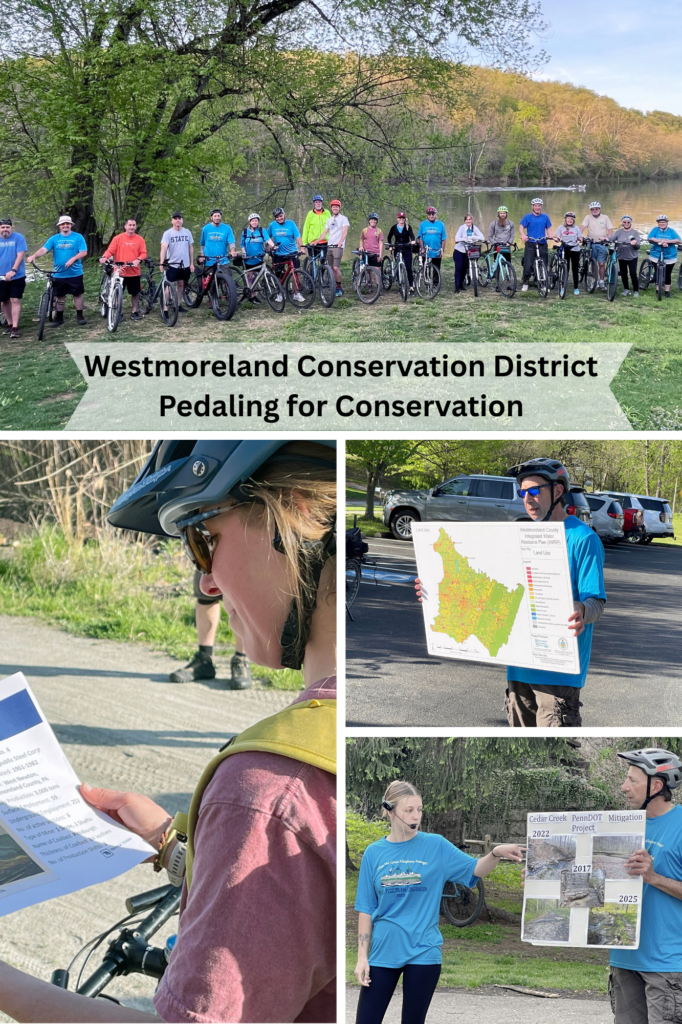
The Westmoreland Conservation District hosted a bike ride along the Great Allegheny Passage as a way to educate participants about water quality issues in the county. During the 7 mile (roundtrip) ride, the 26 participants made multiple stops that showcased water quality improvement initiatives, such as abandoned mine site reclamation, mine drainage treatment, streambank stabilization, stream water quality testing, and illegal tire dumping in the river. Speakers on the trip included staff from the district, Tetra Tech, and the Mountain Watershed Association.
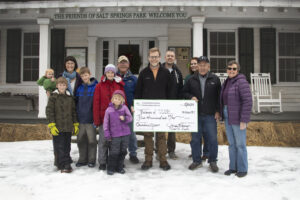
The events were funded by a nonpoint source mini-grant from PACD, Flat Tire Co., and Bove Engineering.
 Financial and other support for this project is provided by the Pennsylvania Association of Conservation Districts, Inc. through a grant from the Pennsylvania Department of Environmental Protection under Section 319 of the Clean Water Act, administered by the U.S. Environmental Protection Agency.
 Submitted by Jennifer Brooks, Environmental Education and Outreach Coordinator, Berks County Conservation District
 Financial and other support for this project is provided by the Pennsylvania Association of Conservation Districts, Inc. through a grant from the Pennsylvania Department of Environmental Protection under Section 319 of the Clean Water Act, administered by the U.S. Environmental Protection Agency.
 The Pennsylvania Department of Labor & Industry announced a more than $6.6 million investment in 19 Pennsylvania organizations to develop and expand registered apprenticeship and pre-apprenticeship programs in the agriculture, health care, and information technology (IT) sectors.
 Lancaster County Conservation District (LCCD) celebrated its 75th anniversary with WGAL News 8 on April 21, 2025.